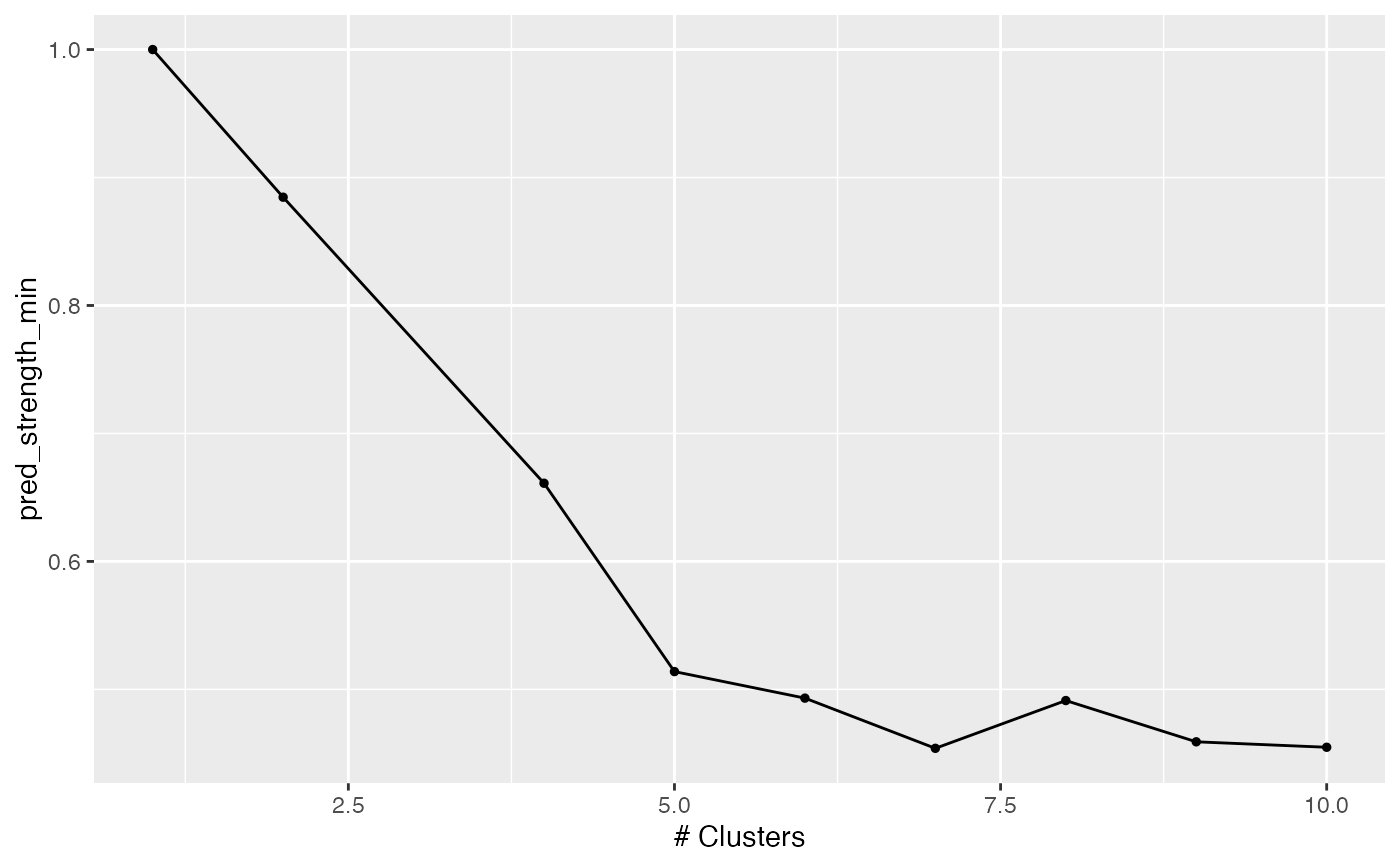
This function estimates the stability of cluster assignments by calculating the prediction strength: how well do cluster assignments of new data from a pre-trained model co-incide with cluster assignments of the same data from a new model fitted on the same data (Tibshirani & Walther, 2005).
Usage
pred_strength_min(object, ...)

# S3 method for class 'cluster_spec'
pred_strength_min(object, ...)

# S3 method for class 'cluster_fit'
pred_strength_min(object, new_data = NULL, ...)

# S3 method for class 'workflow'
pred_strength_min(object, new_data = NULL, ...)Details
Note that this metric will re-fit the model on the new dataset
(new_data), and so might be computationally expensive.
References
Tibshirani, R. and Walther, G. (2005) Cluster Validation by Prediction Strength, Journal of Computational and Graphical Statistics, 14(3), 511-528.
See also
Other cluster metric:
jaccard_avg()
Other ML4Psych:
jaccard_avg(),
metric_by_event()
Examples
library(tidymodels)
library(tidyclust)

penguins <- drop_na(penguins)

kmeans_spec <- k_means(num_clusters = tune())

res <- tune_cluster(
  kmeans_spec,
  ~ bill_length_mm + bill_depth_mm + flipper_length_mm + body_mass_g,
  resamples = vfold_cv(penguins, v = 2, repeats = 10),
  metrics = cluster_metric_set(pred_strength_min)
)

# What's the largest k that has a good prediction strength?
# (values above 0.8 are considered good)
autoplot(res)